Budgeting in Kafu
A self-initiated concept exploring how a fintech app could surface monthly budgeting in a way that helps people act before they overshoot, not after the money's already gone.
Designed to help people before they overshoot

Where it all started
Young salaried users in the UAE quietly run out of money before payday. Coffee runs, taxis, food delivery, and forgotten subscriptions add up faster than they realise.
Mobile banking apps are good at showing what was already spent. They're far less good at showing how much is still left, while there's still time to act on it.
The bank app shows totals, but only after the damage is done.
What I was solving for
The goal was to put a clear, persistent answer to "how much can I still spend?" at the front of the experience, where it can actually change behaviour, without nagging.
Why does the app only tell me after I've overspent?
Where do I look to know I'm still okay?
Two signals would tell us it's working
- Stay-under-budget rate: users who finish the month within their own limit
- Budget check frequency: how often the surface is trusted enough to be referenced
"A heads-up at 80% is useful; anything earlier and I ignore it."
Recurring theme from user conversations
How I approached it
I started with the people. I gathered quotes from young salaried professionals, clustered them into an affinity map, and traced a full monthly money cycle to find exactly where awareness broke down, before designing a single screen.
The journey
-
Discovery & affinity mapping
Gathered representative quotes from young salaried professionals and clustered them into themes.
-
Customer journey map
Mapped a typical monthly cycle, payday to late month, to find friction points and intervention moments.
-
User stories
Turned the themes and journey into five user stories that defined the MVP scope.
-
Competitive analysis
Studied how N26 and Revolut handle budgeting on iOS to find the gap worth owning.
-
Design & flow
Designed the budgeting flow end to end, from setting a monthly amount to tracking the live cycle.
-
Arabic / RTL
Prototyped the budget screens mirrored to validate the layout for half the UAE audience.
What research surfaced
Four themes emerged from the affinity map, and each one mapped cleanly to a design implication.
- Blind spending triggers: small contactless payments happen on autopilot; solve visibility with categorisation, not data entry
- No real-time awareness: surface budget state passively, so it's seen without being sought
- Category confusion: smart auto-categorisation reduces decision fatigue; after-the-fact edits preserve agency
- Alert preferences: customisable thresholds plus snooze respect how each person wants to be warned
"Analytics is retrospective: what did I spend? Budgeting is proactive: what can I still spend? A daily-use feature earns its own seat at the tab bar, not a sub-page two taps away."
The key insight from competitive analysis
Designing the solution
The MVP came down to four product decisions, each tied directly to a research theme, and a flow that walks the user from setting a monthly amount, through reminder preferences and category allocation, into the live overview that tracks the month.
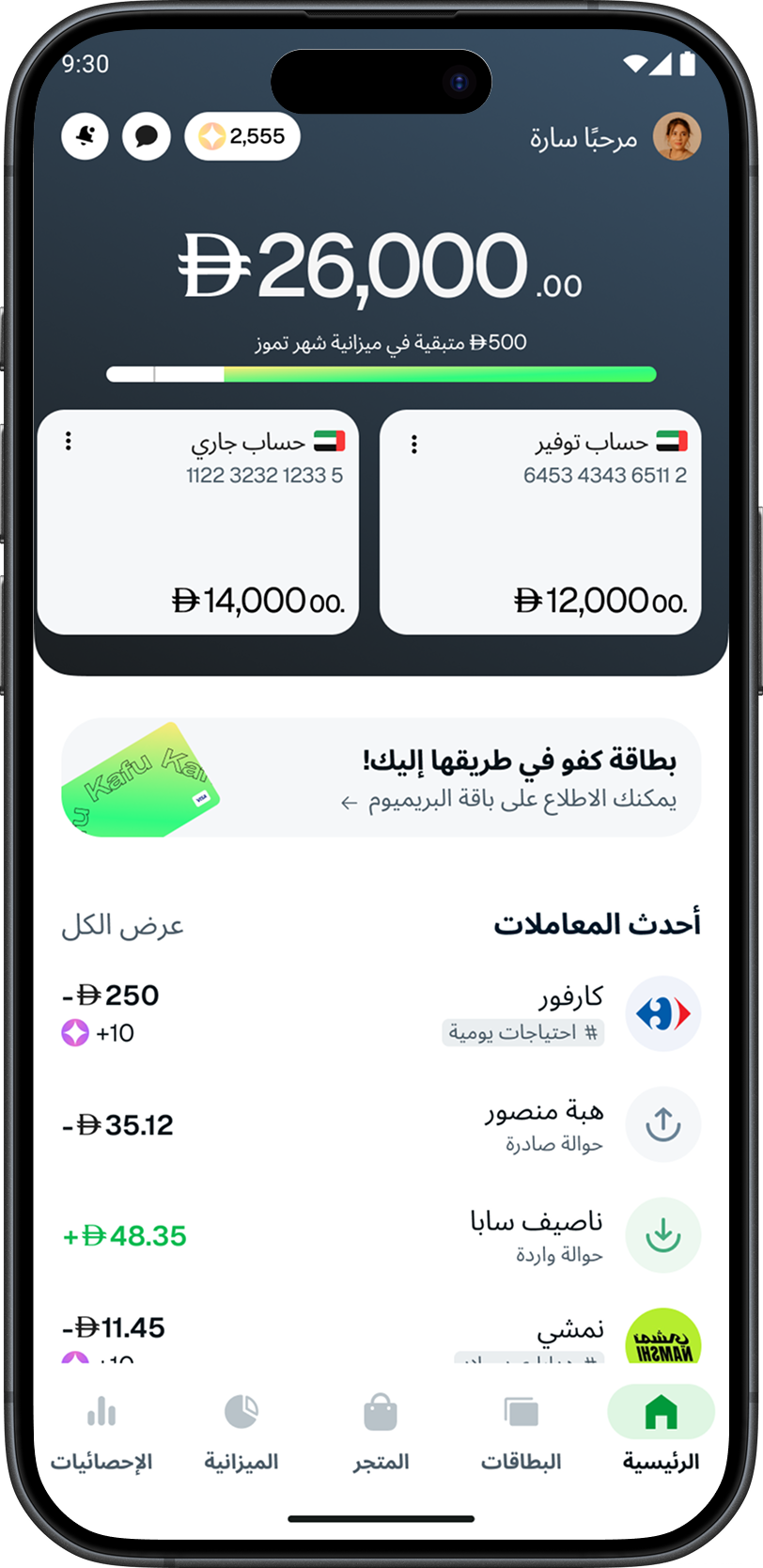
- Persistent budget widget: "Used / Total" with a progress bar, visible the moment the app opens
- Smart auto-categorisation: suggests a category from the merchant and amount; the user confirms or overrides
- Customisable alert thresholds: 80 / 90 / 100%, any combination, with snooze
- Monthly budget prompt: a single-screen nudge to set the budget when salary lands


Built for Arabic, too
Half the UAE reads Arabic, so RTL wasn't an afterthought. It was a test. I rebuilt the budget screens mirrored to confirm the widget, progress bar, and category list survived the flip without losing readability.
What I'd carry forward
- Placement is a feature: daily-use tools earn first-class real estate, not a sub-page two taps away
- Alert design is taste, not science: letting users choose turns a friction into a perceived feature
- Localisation surfaces design debt early: RTL is a litmus test, not an afterthought
Looking back
What started as a "show me my budget" idea became a study in proactive design, surfacing the right number at the right moment so people can act while it still matters.
The hardest part wasn't the widget. It was deciding what deserves to be seen without being sought.
Want to talk through the details?
Happy to walk through the research, the design decisions, and what didn't make the cut.
Get in touch